

Our trusty dive computer – a mainstay of today’s scuba equipment and a crucial piece of kit – but how many of us just strap it on to our wrists before we jump in without knowing its evolution and how it came to be such a critical part of scuba diving. Lets take a look…
At a secret meeting in 1951 at the Scripps Institution of Oceanography in California, members of the US Naval Committee on Undersea War and underwater swimmers discussed improvements in diving equipment. High on their list was a foolproof way to monitor nitrogen loading.
Two years later, two researchers from the Scripps Institute, Groves and Munk, published a paper outlining the functions needed for a decompression device. Such a device, they said, should calculate three things – the decompression during a dive, the nitrogen remaining in the human body from a previous dive, and based on this information, the optimal and fastest rate of ascent. Groves and Monk suggested using an electrical analog computer to measure pressure and air intake.
1955 – Decomputer Mark I

The American company Foxboro introduced a diving computer called Decomputer Mark 1
It was the first analog diving computer. A needle indicated danger while going up by moving towards a red area on the screen.
After several diving tests, the US Navy found that the device did not perform as expected and did not correctly calculate the decompression status. Despite their best efforts, the use of diving charts was still more accurate.
1963 – SOS Poseidon 5

In 1963 the Poseidon 5 was introduced. The device calculates how long you need a safety stop based on the depth and time of the dive. However, the calculations were so inaccurate for deep and frequent dives that this device was dubbed the Bend O Matic, and the US Navy advised against its use.
1963 – Tracor

The market witnessed the first electromechanical device TRACOR. The unit relied on two batteries, but the high power consumption, especially in cold water, resulted in limited diving times and an alarming rate of system failure.
1979 – XDC-1

The next important development came in 1979 with the introduction of the XDC-1. It was a purely laboratory computer that looked like a cashier. The XDC-1 was a desktop computer that was connected to the diver by a cable with a pressure sensor.
With the beginning of the 1980s, the digital transformation of diving computers began.
The US Navy’s research in the field of diving has been credited with finding a device that helps military divers in their underwater war missions.
1982 – Model XDC-3 appeared.
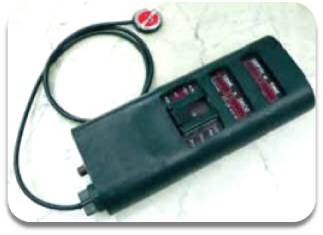
The Model XDC-3 was, and still is, the first true diving computer. XDC-3 700 copies sold. The XDC-4 was an improved version that was able to be calculated based on different gas mixtures. For most divers, or indeed almost all divers, this device was expensive to purchase at the time.
At about the same time, Dacor introduced a DDC that was the first modern device to display all the necessary basic information, depth, maximum depth, dive time, surface time, saturation level.
The DDC was able to store information for frequent dives and had a sensor to warn if the ascent speed exceeded 20 meters per minute. It also has an LED light to warn if the pressure limit is exceeded.
1983 – Orca Edge

The Orca Edge has arrived on the market as the first commercially salable diving computer. The model was built on US Navy dive charts but did not calculate the decompression plan. It was designed ahead of its time
1984 – Decobrain


Decobrain was introduced and designed by the Swiss start-up Divetronic AG. Decobrain can be considered as the first recreational diving computer. View all the data we expect from a modern diving computer. Including calculated climb times and an integrated warning system for rapid ascent.
1985 – Dacor Microbrain

Dacor introduced Microbrain as the successor to the DDC. The notable innovation of this device was that it uses a specially designed silicon chip that works faster and more reliably. It also requires less energy and can even be found in use today.
1986

The Finnish company Suunto introduced its first diving computer in 1986. It was the SME-ML. It was a really cool piece of technology that had all the essential features that a modern diving computer has. It was even able to store 10 hours of immersion. Diving log was available all the time to the diver
SME-ML The base model was based on US Navy diving schedules. The battery can last up to 1500 hours. The maximum depth was up to 60 meters. SME-ML had a very simple design and introduced Suunto to the market. All the essential information was available at once and was easy to use.
1987 – Aladin

The Swiss company UWATEC hit the market in 1987 with the Aladdin device. At the time, it ousted almost all competitors to become one of the best standard devices used by divers. Its maximum depth was 100 meters. The recommended rate of ascent is set at 10 meters per minute. Including calculated climb times and an integrated warning system for rapid ascent. But it was ugly, somewhat bulky, and gray in design.
There has been no drastic change in diving computers since the late eighties. Certainly now smaller, more capable and definitely more reliable. This allowed diving computers to become more common and today the majority of divers use a dive computer.
However, the basic functions of this modern marvel of technology remain the same as its predecessors in the late eighties. Additional features introduced are calculations for different gas mixtures, digital compass, high capacity diving logs…etc.
Check out our range of modern dive computers here
